
The Big Four: Which Parenting Style Defines Your Home?

Every parent has moments when they pause and evaluate their approach to raising children. You might catch yourself using a phrase your own parents used thirty years ago, or find yourself stepping back and allowing your child total freedom because you do not have the energy to enforce a boundary. Parenting is rarely a linear journey, and most of us adapt our responses depending on how tired we are, our child’s temperament, or the specific challenge of the day.
Table of contents
- The Science Behind How We Parent
- The 4 Parenting Domains?
- 1. Authoritative Parenting: (High Warmth, Healthy Boundaries)
- How Does This Look in Practice?
- 2. Authoritarian Parenting: (Strict Rules, Low Warmth)
- How Does This Look in Practice?
- 3. Permissive Parenting: High Warmth, Few Boundaries
- 4. Uninvolved Parenting: Low Warmth, Low Boundaries
- Shifting Your Framework: How to Become More Authoritative
- What Comes Next in Our Series
Estimated reading time: 8 minutes
But experts in child development have noticed that a basic framework determines our daily choices.
First conceptualized by psychologist Diana Baumrind in the 1960s and later expanded by researchers Eleanor Maccoby and John Martin. They found that parenting usually falls along two main lines: emotional warmth (how responsive you are) and behavioural expectations (how much you expect from your child).
When these two factors merge, they create four main parenting styles. Knowing which style fits your home is not about labelling yourself or feeling bad about what you have done before. Instead, it helps you see your habits more clearly so you can build a calm, organized, and close family life.
The Science Behind How We Parent
Many people think parenting styles are simply about personal choice or culture. But research shows that the mix of care and boundaries has a big impact on how children manage their emotions, do in school, and manage challenges as they grow up.
A large study in the Journal of Family Psychology looked at how different parenting styles affect a child’s ability to manage their emotions. The researchers found that any supportive parenting, with lots of care and clear rules, helps kids learn to handle their feelings well as they grow. On the other hand, harsh or strict discipline makes it harder for children to develop emotional control on their own.
The 4 Parenting Domains?
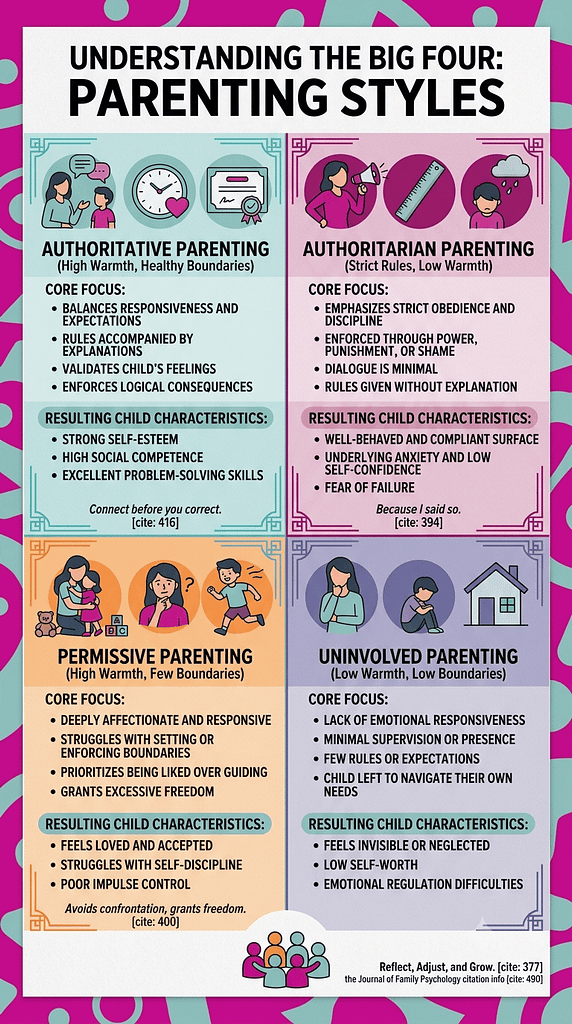
When we look at the four main parenting styles, it is clear that different levels of emotional warmth and structure shape how children grow and think.
1. Authoritative Parenting: (High Warmth, Healthy Boundaries)
Authoritative parenting is often considered a gold standard in child development. It combines being loving and responsive with setting clear and reasonable rules. In this type of home, parents are more like helpful guides instead of strict enforcers or detached observers. They create rules and explain why they’re important. If a child messes up, the parent offers a fair consequence while also being attentive to the child’s feelings and supporting them through the situation.
How Does This Look in Practice?
For instance, if a child refuses to put away their toys before dinner, an authoritative parent might say, “I know you are having fun playing right now, and it is hard to stop. However, toys need to be cleared because it is dinner time. Once dinner is over, you can continue playing with your toys.”
Long-Term Impact on Children
Kids raised with authoritative parenting usually have good self-esteem, strong social skills, and can solve problems well. Since their feelings are respected and their voices hold weight, they see boundaries as helpful and safe, not just rules to control them.
2. Authoritarian Parenting: (Strict Rules, Low Warmth)
Authoritarian parenting emphasizes strict rules, discipline, and high expectations, but often with lower levels of emotional warmth or verbal give-and-take. The emphasis is placed heavily on conformity and respect for authority. In this type of home, dialogue is minimal between children and parents. And children are rarely given explanations for why a rule even exists beyond the phrase, “Because I said so.”

How Does This Look in Practice?
If a child struggles to complete their homework or displays frustration about a house rule, an authoritarian response might sound like, “Stop complaining and get it done immediately; that’s why we send you to school every day. Or you’ll lose your privilege for a month. We send you to school to learn and understand your homework.”
Long-Term Impact on Children
Children with authoritarian parents might seem well-behaved, but they often deal with anxiety, low confidence, and fear of making mistakes. Since they do not get to make many choices, they may have trouble being independent or might rebel when they are older.
3. Permissive Parenting: High Warmth, Few Boundaries
Permissive parents are very loving and caring, and they respond to their children’s feelings. But they often have a hard time setting and keeping rules.
In a permissive home, parents often want their children to like them more than they want to guide them. They avoid arguments, give a lot of freedom, and rarely ask for mature behaviour or chores. Even when they set rules, they do not always stick to them, often because they feel guilty or stressed when their child is upset.
What It Looks Like in Practice

If a child demands an ice cream or candy right before dinner and throws a tantrum when told no, a permissive parent might quickly give in. Saying, “Okay, fine, just eat half of it so you do not ruin your appetite for supper. You can stop crying now.”
Long-Term Impact on Children
Kids raised by permissive parents usually feel loved, but they may have trouble with self-control and managing their emotions. In the absence of clear rules, they can feel a bit insecure, like no one is really in charge.
4. Uninvolved Parenting: Low Warmth, Low Boundaries
Uninvolved parenting, also called neglectful parenting, means there is minimal emotional support and few rules or limits. In an uninvolved home, parents are mostly disconnected from their child’s daily life. This can happen because of stress, mental health issues, money problems, or not knowing how to parent. There is little communication or expectation, and the child is left to handle things on their own.
What It Looks Like in Practice
An uninvolved parent may not know who their child’s friends are, whether homework is being completed, or what emotional struggles the child is facing, offering little to no presence, structure, or supervision.
Long-Term Impact on Children
Children raised with uninvolved parenting face the biggest challenges. They often have low self-esteem, trouble in school, and problems managing their emotions. Many feel invisible or have to grow up too soon.
Shifting Your Framework: How to Become More Authoritative
If you notice your home is more authoritarian or permissive than you want, be kind to yourself. Most parents use a mix of styles, and stress can make anyone fall back on old habits. encouraging reality of human development is that parenting styles are not fixed traits. You can intentionally shift your daily habits to cultivate an authoritative framework in your home through a few foundational practices.
While I was researching this article, the guilt hit me about my permissive parenting toward my youngest son. I had no idea that I’ve been so permissive until I read the journal article by Baumrind. I’m looking forward to making some changes before we head back to school. My youngest one is only 5, and I really want him to get the same discipline and mom support as his older siblings.
Validate Before You Discipline
Try to connect with your child before correcting them. If your child is upset or pushing against a rule, notice their feelings first. Accepting their emotions does not mean you accept bad behaviour- it just shows your child you see how they feel before you talk about what happened.
Explain the “Why” Behind Rules
Do not just rely on your authority. Take a moment to explain why you have certain rules. When kids know that rules are for safety, fairness, or respect, they are more likely to understand and follow them, not just obey out of fear.
Maintain Firm Boundaries with Soft Energy
You can stick to your rules and still speak gently. You do not need to yell or threaten. Being calm and consistent shows your child that you are steady and in control.
What Comes Next in Our Series
Knowing your main parenting style is the first step to building a peaceful home where your kids feel safe and listened to. When we see how our rules and warmth affect our children, we can start to work on the ways we talk and connect with them.
Check out our previous article, “Why Your Kids Stopped Venting?” We looked closely at the everyday habits that can make kids stop sharing with us. We also talked about small changes in how we listen that can help rebuild strong connections.
Think about your own childhood and your home now. Which parenting style feels most natural to you? What is one change you want to try this week, maybe setting a new boundary or showing more warmth?
Share your thoughts in the comments!
Share this content:




Leave a Reply